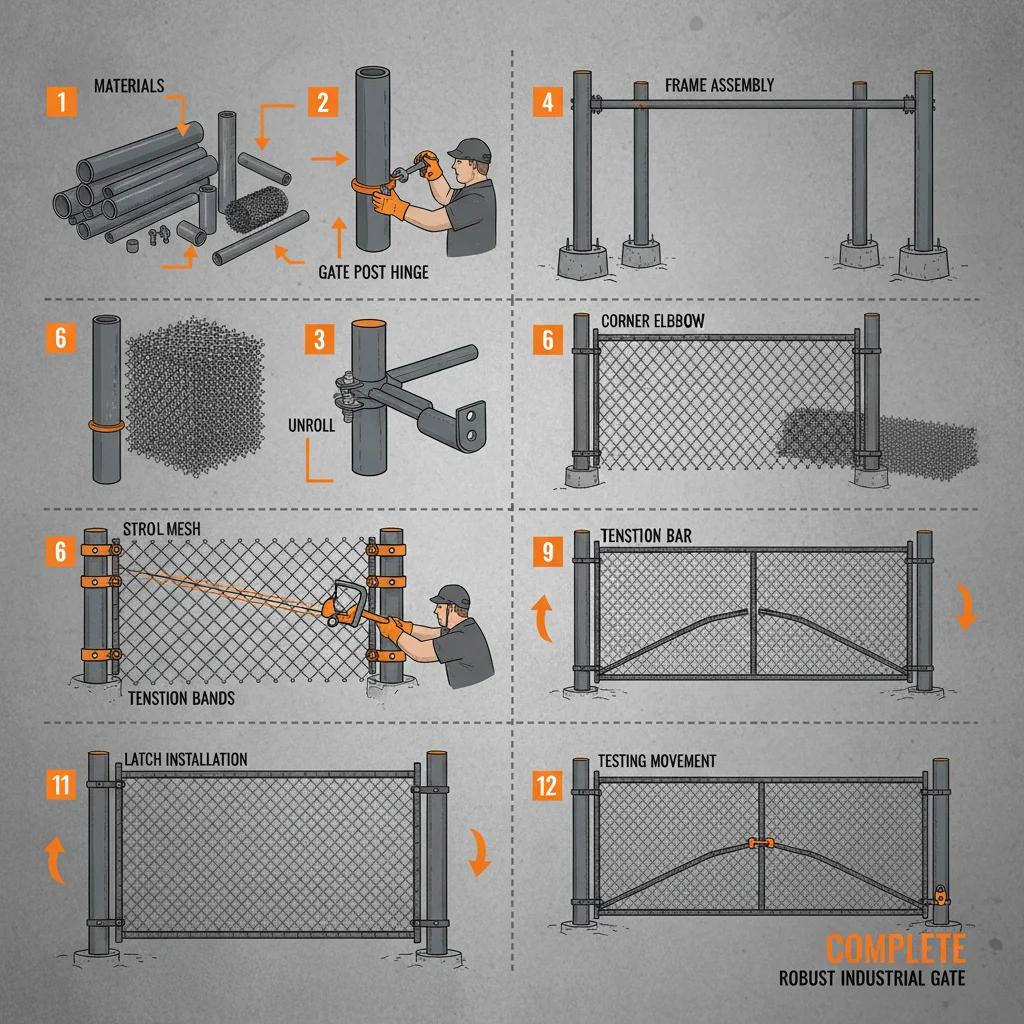
When planning the perimeter security for a construction site or industrial zone, understanding the 100 ft chain link fence cost is often the first step in budget allocation. While traditional permanent installations offer long-term stability, the modern industry is shifting toward modular, high-performance temporary solutions that provide similar security without the prohibitive installation overhead.
Evaluating the 100 ft chain link fence cost requires a look beyond the initial price of materials. One must consider the labor involved in excavation, the cost of concrete footings, and the eventual expense of removal, which often makes permanent fencing significantly more expensive for short-to-medium term projects.
By analyzing the 100 ft chain link fence cost in comparison to modular steel panel systems, project managers can realize substantial savings in labor and time while maintaining a professional-grade security barrier.
Analyzing the Value of 100 ft Chain Link Fence Cost
When calculating the 100 ft chain link fence cost, it is essential to differentiate between the raw material price and the total cost of ownership. For many industrial sites, the perceived low cost of chain link fabric is offset by the high cost of installing permanent posts and the labor-intensive process of tensioning the wire to prevent sagging over time.
In contrast, adopting a modular approach using high-strength industrial steel and precision welded wire mesh offers a different value proposition. While the upfront procurement might differ from a basic 100 ft chain link fence cost, the ability to deploy without excavation and relocate panels across multiple projects creates a much higher return on investment.
Global Standards in Perimeter Security Materials
On a global scale, perimeter security is governed by strict safety regulations and ISO standards to ensure that barriers can withstand environmental pressures such as high wind loads. The traditional approach often focuses on the 100 ft chain link fence cost as a baseline, but industrial zones are increasingly moving toward hot-dip galvanized steel to prevent corrosion in harsh climates.
A significant challenge faced by the construction and mining industries is the need for rapid deployment. Traditional fencing requires weeks of site preparation and digging, which can disrupt local ecosystems and delay project timelines, leading to indirect costs that far exceed the initial material budget.
To address these challenges, the industry has shifted toward non-invasive installation methods. By utilizing rubber or concrete bases, professional-grade modular systems eliminate ground damage, ensuring that site boundaries are secure and compliant with international safety codes without permanent environmental modification.
Core Components Affecting 100 ft Chain Link Fence Cost
The primary driver of the 100 ft chain link fence cost is the quality of the steel and the surface treatment applied. High-strength industrial steel combined with hot-dip galvanizing ensures that the barrier remains structurally sound for years, resisting the oxidation that typically plagues lower-grade wire products.
Another critical factor is the installation method. While a standard 100 ft chain link fence cost includes digging and pouring concrete, modular systems use a clamp/coupler system. This "plug-and-play" approach reduces onsite labor hours and allows for flexible layouts that can be reconfigured as the project evolves.
Finally, customization options such as anti-climb mesh or privacy screens can influence the overall 100 ft chain link fence cost. By adding these specialized components, operators can transition a basic boundary into a high-security zone capable of restricting unauthorized access more effectively than standard chain link fabric.
Cost Efficiency of Modular vs Permanent Systems
Comparing the long-term financial impact of a permanent 100 ft chain link fence cost against modular portable panels reveals a stark contrast in labor and reusability. Permanent fences are essentially "sunk costs" because once they are installed and later removed, the materials often have little to no salvage value.
Modular systems, however, are designed for a lifecycle of multiple projects. The use of durable powder coating and rigid steel frames allows these panels to be dismantled and transported, effectively spreading the initial investment across several different job sites and drastically lowering the per-project cost.
Comparison of Long-Term Investment vs 100 ft Chain Link Fence Cost
Industrial Applications of Portable Fencing
In remote industrial zones and large-scale construction sites, the agility to move a perimeter is more valuable than the static nature of a permanent installation. While a 100 ft chain link fence cost might seem attractive for a simple boundary, portable panels allow for rapid reconfiguration into straight lines, corners, and access points as construction phases evolve.
Furthermore, in public event management or temporary disaster relief zones, the speed of deployment is critical. The ability to establish a secure physical barrier in hours rather than weeks ensures site safety and crowd control without the need for disruptive ground excavation or permanent modification of the venue.
Long-Term Investment and Reusability
The true economic advantage of choosing modular steel over a standard 100 ft chain link fence cost lies in lifecycle management. Industrial-grade corrosion-resistant finishes mean that these panels do not degrade after a single season of outdoor exposure, allowing them to be stored and redeployed.
Asset tracking systems now enable companies to monitor their panel inventory across multiple sites. This optimized resource allocation ensures that materials are not wasted and that the investment in high-quality steel panels continues to provide value long after the first project is completed.
By focusing on the durability of the frame and the precision of the welded wire mesh, owners can avoid the recurring costs associated with repairing sagging chain link or replacing rusted posts, transforming a security expense into a reusable corporate asset.
Technical Comparison of Fencing Solutions
When choosing a system, one must look at the technical specifications that justify the difference between a basic 100 ft chain link fence cost and a professional modular system. Structural stability, particularly wind load resistance, is a key differentiator; rigid steel frames prevent the buckling often seen in lightweight chain link setups.
Installation logistics also play a role. The transition from specialized crews required for excavation to a minimal workforce for "plug-and-play" modular panels significantly reduces operational downtime and labor overhead, which are often the hidden costs of traditional fencing.
Ultimately, the choice depends on the intended duration of the site. For permanent boundaries, traditional methods persist, but for any project requiring flexibility, the modular approach outperforms the traditional 100 ft chain link fence cost in every metric of efficiency and adaptability.
Technical and Economic Comparison: Permanent vs. Modular Fencing
| Feature Dimension |
Permanent Chain Link |
Modular Steel Panels |
Economic Impact |
| Installation Time |
Weeks (Excavation) |
Hours (Modular) |
High Labor Savings |
| Ground Impact |
Permanent Damage |
Zero Surface Impact |
Lower Site Restoration Cost |
| Reusability |
Zero (Fixed) |
High (Multi-project) |
Reduced Long-term Spend |
| Stability |
Tension-dependent |
Rigid Frame Stability |
Lower Maintenance Cost |
| Flexibility |
Static/Rigid |
Fully Portable |
Adaptable Site Layouts |
| Upfront Cost |
Low (Materials only) |
Moderate (Steel-grade) |
Higher Initial ROI |
FAQS
While the initial material cost for a basic chain link fence may be lower, the total cost of ownership for modular panels is typically lower over time. This is due to the elimination of expensive ground excavation, significantly reduced labor hours for installation, and the high reusability of steel panels across multiple projects, whereas permanent fencing must be discarded.
Yes, professional-grade modular panels are specifically engineered for high wind load resistance. Unlike chain link fabric that can billow or sag, our panels utilize rigid industrial steel frames and precision welded wire mesh, which can be further stabilized with optional stabilizer bars to ensure safety in harsh outdoor environments.
No ground excavation is required for our modular systems. Instead of digging holes and pouring concrete—which adds significantly to the 100 ft chain link fence cost—these panels are supported by specialized rubber or concrete bases. This ensures a non-destructive installation process that preserves the site's surface.
Our panels undergo industrial-grade surface treatments, including hot-dip galvanizing or powder coating. This creates a durable barrier against moisture and chemicals, ensuring long-term structural integrity and reducing maintenance costs compared to standard galvanized chain link, which can rust at the joints.
To increase the security level beyond a standard barrier, we offer several customizable options. These include anti-climb mesh to prevent scaling, lockable gates for controlled access, privacy screens to block visibility, and stabilizer bars for additional structural rigidity in extreme weather.
Absolutely. The systems are designed with a lightweight yet durable steel construction, making them ideal for easy handling and transportation. Their modular nature allows them to be stacked compactly for storage and quickly deployed on any new site, maximizing the utility of your investment.
Conclusion
In summary, while the 100 ft chain link fence cost provides a common benchmark for perimeter budgeting, the shift toward modular, professional-grade steel panels represents a more strategic approach to site security. By prioritizing reusability, rapid deployment, and non-invasive installation, project managers can ensure a high level of protection while significantly reducing long-term labor costs and environmental impact.
Looking forward, the integration of asset tracking and sustainable materials will further enhance the value of modular fencing. Investing in high-quality, corrosion-resistant portable systems not only secures the present project but builds a durable infrastructure that can be leveraged across all future operations. For professional-grade security solutions, visit our website: www.cowanfences.com